Denver → Summit County
Denver to Summit County Car Service
95 miles west through one tunnel, and then down into a basin with three towns in it. Frisco, Silverthorne and Dillon all sit below the four ski areas around them — Silverthorne is 810 feet below Breckenridge — and on the first night that gap is the number that matters.
Elevation profile
- Distance from DEN
- 95 mi
- Typical drive
- 1h 30m–2h
- Climb from DEN
- 5,878 ft
- SUV from
- $490
Passes on this route
- Eisenhower Tunnel 11,158 ft highest vehicular tunnel in the United States
Rates by vehicle
One way, per vehicle — SUV, up to 6 passengers. Taxes, tolls and gratuity included. Photos show the models we drive, not our own cars.
Get a quote for this vehicle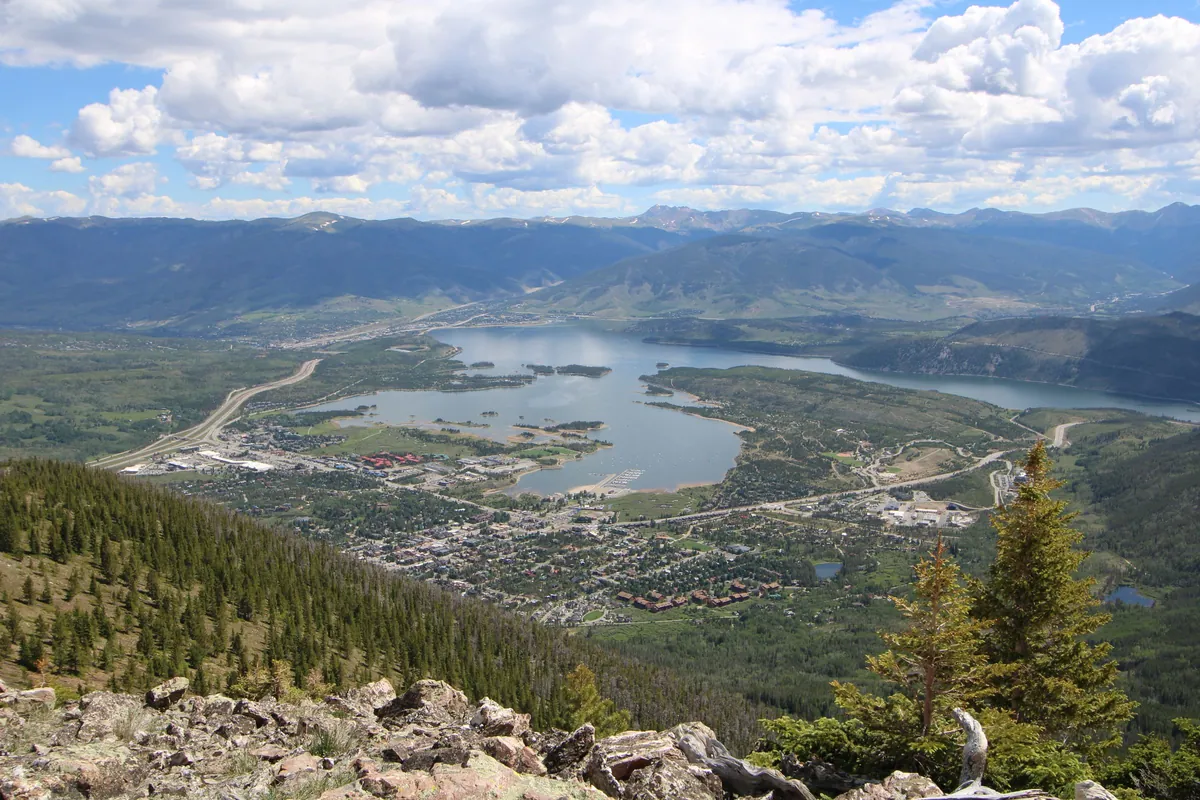
810 feet below Breckenridge
Silverthorne sits at 8,790 feet. Frisco is at 9,026. Dillon is at 9,111.
Now compare those with what surrounds them. Keystone’s base is 9,280. Breckenridge is 9,600. Copper Mountain is 9,712. Arapahoe Basin is 10,780. Silverthorne is 810 feet below Breckenridge, which is both a resort and a town with plenty of beds in it — so the choice here is between two bedrooms, not between a bedroom and a chairlift.
That 810 feet is worth planning around. Doctors advise gaining no more than 1,000 feet of sleeping elevation per night above 8,000 feet, and nobody flying into Denver manages it: the gain from the airport is 3,510 feet to Silverthorne and 4,320 feet to Breckenridge. Both blow through the guidance. But 810 of those feet are the part you actually get to choose, and you choose them when you book the room. There is more on how that plays out in our guide to altitude on a Colorado ski trip.
The drive itself reaches 11,158 feet at the Eisenhower Tunnel, about 60 miles west of Denver, and then loses more than 2,000 feet putting you in the valley. The two bores are not identical: the westbound Eisenhower runs 1.693 miles, the eastbound Johnson 1.697.
Three towns, four mountains
Frisco, Silverthorne and Dillon sit within a few minutes of each other around the same reservoir, and they function as one place with three sets of signage. Together they put Keystone, Breckenridge, Copper Mountain and Arapahoe Basin within short driving distance of a single bed. The town of Frisco puts Vail at 26 miles.
That is the reason groups who cannot agree on a mountain end up here. One booking, four options, decided at breakfast.
The towns themselves are small: 2,913 people in Frisco, 4,402 in Silverthorne, 1,064 in Dillon at the 2020 census. In February those numbers stop meaning anything.
You may not need a car once you arrive
Summit County runs its own bus system, the Summit Stage, and it is free to ride within the county. No fare box, no pass.
If you are staying in the valley, that changes the arithmetic on a rental car. Four days of parking, scraping windows and driving mountain roads at altitude, against a bus that costs nothing. Book the transfer in, ride the Stage, book the transfer out.
The reservoir the towns are built around
Dillon Reservoir is not a scenic pond. It holds 257,304 acre-feet across 3,233 acres, with 26.8 miles of shoreline, and it is the largest reservoir Denver Water owns — roughly 40 percent of the city’s entire supply.
The water does not reach Denver downhill. It goes east through the Roberts Tunnel, bored under the Continental Divide, and comes out on the other side of the mountains. The reservoir first filled in 1965, and the three towns arranged themselves around the new shoreline afterwards.
Two stops worth knowing about
The Outlets at Silverthorne run about 40 stores directly off the interstate. That makes them the default answer when a flight lands in the morning and the room is not ready.
Frisco’s Main Street still has its original buildings. The schoolhouse went up in 1902 and is now on the National Register of Historic Places, part of the town’s historic park.
Sunday afternoon is the trip that goes wrong
The drive up is rarely the problem. The drive back is.
Eastbound I-70 on a Sunday peaks between 3 and 6 PM, and CDOT puts the start of the build-up as early as 11:30 in the morning. Three of the four known chokepoints are ahead of you leaving the valley — the tunnel approach, the Georgetown to Silver Plume corridor and the Floyd Hill descent. The fourth is Vail Pass, which is behind you, and which sends its traffic into yours at Copper.
Miss the window and a 90-minute drive stops being 90 minutes, with a flight at the end of it. Work the departure backwards from your gate rather than forwards from checkout. On a peak Sunday that usually means leaving the valley before lunch.
What the price includes
$490one way, per vehicle (SUV, up to 6 passengers), everything included
- Airport waiting included — a delayed flight is not a rebooking
- Flight tracking — pickup moves with your arrival
- Your driver waits at the vehicle in the designated pickup area, not inside the terminal
- I-70 Mountain Express Lane tolls on peak days
- Child seats at no charge, on request
- Bottled water in the vehicle
- Gratuity — included, not added at the end
- Traction-law compliant vehicle, September through May
No meter, no surge pricing, no fuel surcharge. The number you are quoted is the number you pay.
Per vehicle or per seat: the actual math
Shared shuttles charge each passenger. We charge for the car. Which one wins depends entirely on how many of you are travelling.
| Passengers | Shared shuttle, total | Our car | Per seat with us | Cheaper |
|---|---|---|---|---|
| 1 | $50–$65 | $490 | $490 | Shuttle |
| 2 | $100–$130 | $490 | $245 | Shuttle |
| 3 | $150–$195 | $490 | $163 | Shuttle |
| 4 | $200–$260 | $490 | $123 | Shuttle |
| 6 | $300–$390 | $490 | $82 | Shuttle |
On price alone the shuttle wins at every group size on this route. Shuttle rates come from the operator's own page: shared shuttle seats start at $50 to the transfer station, $65 door to door.
Price is not the only difference. A shared shuttle, bus or train carries other passengers, makes other stops and leaves on its own schedule. The private car leaves when your flight lands and drives to one address.
Questions we actually get asked
- How long does it take to drive from Denver airport to Summit County?
- 95 miles and 1h 30m–2h in clear conditions. Winter weekends run longer.
- How much is a car from Denver airport to Summit County?
- From $490 one way for an SUV with up to six passengers — the price is for the vehicle, not per passenger. Tolls, child seats and gratuity are included. Larger groups ride in a Sprinter, quoted on request.
- What is the high point of this route?
- Eisenhower Tunnel at 11,158 ft. Weather closes it from time to time, and any detour adds time.
- Do I need snow chains or a special vehicle?
- Not in our car. Colorado enforces its traction law on I-70 between Dotsero and Morrison from September 1 through May 31, and every vehicle in our fleet carries compliant tires for the full season. In a rental it is your problem: the fine is $100 plus a $33 surcharge, and all-wheel drive alone does not satisfy the law.
- Will our skis and luggage fit?
- A Suburban gives 41.5 cubic feet with all three rows up and 98.8 with the third folded. Ski bags are long rather than bulky, so the constraint is usually shape, not volume — tell us the passenger count, bag count and ski bag count and we will size the vehicle.
- Where do I meet my driver at Denver airport?
- Pre-arranged private cars meet passengers on Level 5 of the Jeppesen Terminal, at Island 2. Your driver waits at the vehicle in the designated pickup area, not inside the terminal.
- What happens if my flight is delayed?
- Airport waiting is included in the price. A delayed flight is not a rebooking.